
The root pass also plays an integral role in creating a strong and durable weld. A good root pass by Big Easy Mobile Welders allows for deep penetration and alignment of the beveled pipe sections, forming a strong foundation for the fill and cap passes that follow. Whether in the oil and gas industry or construction, getting that root pass right matters.
It keeps out corrosive environments to prevent leaks and maintain safety under high pressure. By ensuring this critical step is done perfectly, you increase the overall quality of your final welds and significantly reduce the chances of expensive repairs or failures.
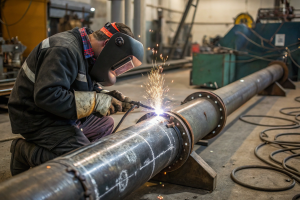 In pipe welding, the root pass is the first weld bead you put down on the joint. It lays the groundwork for the rest of the welding process. Sometimes it necessitates techniques such as burning through tack welds to obtain the proper fusion. It acts as the foundation layer that fuses the materials with strength while waterproofing the seam.
While fill and cap passes are more concerned with reinforcement and overall appearance, the root pass is purely about penetration. As the first layer of welding deposit, its precision sets the stage for overall weld quality. The key difficulty is keeping the heat input steady. Controlling even a consistent keyhole is essential to avoid defects, which can be more unforgiving at this point.
An integrally strong root pass gives the joint a solid base that keeps the weld from cracking, leaking, and weakening. It equally distributes stress across the weld and follows heavy industry safety standards.
 Correct root penetration is the foundation of a sound and strong weld. This is the only way to ensure a complete root fusion with the base material. This innovative technology produces a joint that both withstands mechanical stressors, corrosion resistance and has long-term durability.
Proper root penetration is instrumental in the load-bearing capacity of a weld joint. When the weld fuses completely at the root, it increases the effective throat depth. Such an increase permits a smaller fillet leg size while maintaining strength. This provides a level of mechanical integrity and structural strength that can endure persistent mechanical stress while providing long-term joint stability, even in dynamic mechanical environments.
Proper root penetration helps to eliminate gaps and voids in the weld root, providing little to no hiding place for moisture or contaminants that can lead to corrosion. This is especially critical in industries subject to severe service conditions, like chemical processing or offshore pipelines.
Getting proper penetration every time means longer-lasting, more durable weldments that will serve their purpose safely for generations of use. Neglecting this important action risks developing cracks earlier than expected, which causes expensive repair or replacement.
Defects such as incomplete fusion, porosity, and cracks are typical with inadequate penetration. These defects compromise the integrity of the joint and frequently require costly rework, adding unnecessary expenses to a project.
In applications where full joint penetration (CJP) is necessary, a lack of penetration can cause premature weld failure under stress or extreme pressure. This is why getting the root password right is so important!
 Providing a good root pass is critical, as this pass provides the foundation for all the subsequent welds. It’s the most critical step, and it’s the first step that ensures the whole weld can take the pressure.
Having good penetration ensures that pipes are well anchored, leaks do not develop, and the entire structure is more durable over time. Whether you’re working on pipelines, industrial systems, or even a smaller home project, getting the root pass right is key to long-lasting results.
It takes precision, technique, and meticulous attention to detail to take them over the top. It’s an intimidating starting point, and cutting corners here can create huge issues later in the process. Which is why seasoned pipe welders understand this pass warrants a little more attention.
Looking for some specialized professional guidance on your next welding endeavor? For all your welding needs, contact Big Easy Mobile Welding. We’re going to deliver quality, reliability, and consistency right to your front door.


 By Admin
  Sep 26, 2025