
A steel trailer in New Orleans can be repaired with a MIG, flux-cored, or stick welder that has enough output for the frame. Self-shielded flux-cored wire and stick electrodes make their own shielding, so they generally cope better with outdoor wind and less-than-clean steel, while gas-shielded MIG needs shelter. The machine matters less than the method: unload and support the frame, find every crack, grind to bright metal, weld, reinforce, and restore the coating.
At Big Easy Mobile Welders, we often see trailer work turn out bigger than the phone call suggested. Someone reports one cracked crossmember and we find three.
That is not upselling. It is what a frame does when it has been flexing for a while, because the load that cracked one member is still going through the rest.
Below, we cover which kind of welder suits the job, then the order the work has to happen in to produce a repair that holds. Contact us today to have a cracked trailer frame or truck bed looked at on site.
A steel trailer can be repaired with a MIG, flux-cored, or stick welder that has enough output for the frame thickness. Self-shielded flux-cored and stick generally cope better with wind and less-than-clean steel outdoors, while gas-shielded MIG needs shelter. Aluminum trailers need a different setup, and any crack at the tongue or coupler calls for an experienced welder.
Whichever machine is used, the load comes off first, because nothing gets inspected properly or welded safely while the trailer is carrying weight. Support the frame on stands at the points the manufacturer intends, not under the middle of a rail.
Level matters as much as support. A frame welded while it is sagging or twisted holds that shape once it cools, and a trailer parked on soft ground in this city often spends years with one corner low.
The reported failure is a starting point, not the full scope. Frames fail in patterns, and the pattern tells you where else to look.
Start at the reported crack and work outward along the same member, then check the corresponding point on the opposite side. Symmetrical loading produces symmetrical cracking, often at a different stage of development.
Pay attention to where a crossmember meets a main rail, because that junction concentrates stress. Cracks there usually start at the toe of the original factory weld.
Wire-brush any suspicious area before judging it. A hairline crack under road grime is invisible, and a rust streak running along a line is often the only clue.
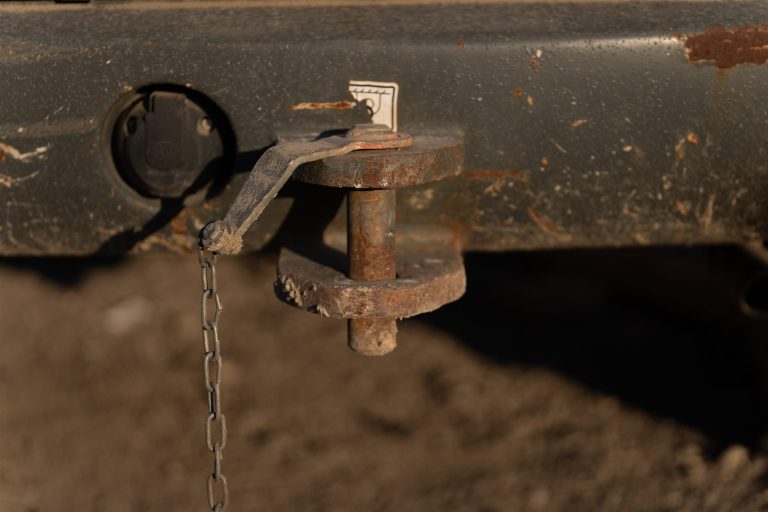 The tongue takes every shock the road delivers and is the most consequential thing on a trailer to get wrong. Any crack in this area is a stop-towing item, not a schedule-it item.
Check the coupler mount, the safety chain attachment points, and the jack mount, all of which are welded to the tongue and all of which crack. Play in the coupler itself is a replacement question, not a welding one.
The tongue is not the area to economize on. It is the connection between a heavy object and a vehicle in traffic.
Hinges carry a shock load every time a ramp drops and are usually the first thing to fail on a utility trailer. Look at the hinge itself, its mounting plate, and the frame immediately behind it.
Latches and catches distort before they break, so a gate that has become hard to close is telling you something. That is generally alignment, not the latch.
Reinforcing a hinge mount at repair time is cheap and prevents the same call in a year. The load is not going to change.
Deck cross supports rust from underneath where nobody looks, particularly on a trailer stored outdoors along the Gulf Coast. Tapping along them with a hammer finds soft sections faster than looking does.
Stake pockets and tie-down points tear out under shock loading, not under steady weight. A torn pocket usually takes some of the rail with it, so the repair is a patch and a pocket rather than just a pocket.
On a truck bed, check the mounting points and the area around them. Our mobile welding service covers this on site so the unit does not have to be transported anywhere.
| Preparation Step | Why It Matters | What Happens If Skipped |
|---|---|---|
| Disconnect the battery and unplug the harness | Welding current follows the easiest path to ground | Damaged wiring, lights, or vehicle electronics |
| Clamp the ground close to the weld | Keeps current out of bearings and suspension | Arcing through wheel bearings |
| Shield tires, brake lines, and hoses | Spatter and radiant heat travel farther than expected | Burned lines or a damaged tire |
| Grind to bright metal both sides | Paint, rust, and coating prevent fusion | Porosity and a weld that fails early |
| Drill-stop the end of the crack | Removes the sharp tip the crack grows from | The crack continues past the repair |
Fire risk deserves its own note in a fuel-carrying environment. Nothing gets welded near a fuel tank, a propane cylinder, or a sealed container without those being removed or properly isolated first.
The same mobile welding safety precautions apply on a driveway as on any job site.
Galvanized coatings have to be ground back well past the weld area instead of burned through. The fumes from welding through galvanizing are a genuine hazard and the weld quality suffers as well.
Weld the prepared joint, then decide whether the area needs reinforcing, not just rejoining. A crack that came from flexing will return unless the stiffness changes.
A fish plate or gusset spreads the load across a wider area instead of concentrating it at one line, and our custom welding covers fabricating one to fit. Placement matters, because a plate ending abruptly creates a new stress point where it stops.
Coating is the step most often left off, and here it decides how long the repair lasts. Bare steel at a weld will be rusting within weeks in a Louisiana summer.
Prime and paint the ground area, and touch up anywhere the coating was burned. On a galvanized trailer, use a cold galvanizing compound instead of ordinary paint.
Reconnect the harness and test every light before we leave the site, because a ground clamp moved during the work is the usual reason a light stops working. Check the brake lines and the nearest tire as well.
Finally, photograph the finished repair from both sides. If that area moves again, the photograph tells you whether the repair held and something else failed, or whether it did not last.
A trailer that has cracked once has told you something about how it is loaded and how it is stored. Repairing the one visible failure and nothing else is the reason the same owner calls again six months later.
At Big Easy Mobile Welders, we survey the frame before quoting and come to the trailer rather than asking you to move it. Call us today to have a cracked frame, tongue, or bed assessed on site.
In most cases yes, provided the crack is prepared properly and the cause is addressed. The repair involves drill-stopping the end of the crack, grinding to bright metal, welding, and usually reinforcing the area. A crack from flexing will return if only the weld is replaced.
Yes. Welding current follows the easiest path to ground, and if that path runs through the wiring harness it can damage lights, brake controllers, and vehicle electronics. Disconnect the battery, unplug the harness, and clamp the ground close to the weld.
Not without removing or properly isolating the tank first. The same applies to propane cylinders and any sealed container, which can rupture from heat alone. This is one of the few parts of trailer repair where there is no acceptable shortcut.
Because the load path has not changed. A crack where a crossmember meets a main rail is a stress concentration, and rewelding it returns it to the same condition. Reinforcing with a gusset or fish plate spreads the load instead of concentrating it.
Yes, but the coating has to be ground off well beyond the weld area rather than burned through. Welding through galvanizing produces hazardous fumes and a poor weld. Afterward, restore the coating with a cold galvanizing compound rather than ordinary paint.
Always. A loaded frame is under stress, and a repair made while it is deflected locks that deflection in once it cools. Support the frame on stands at the manufacturer’s intended points and confirm it is level before any welding begins.
Wire-brush the suspect area first, since road grime hides hairline cracks and a rust streak along a line is often the only visible clue. Tap along deck supports with a hammer to find soft, corroded sections. Then check the same point on the opposite side.
For a private utility trailer, generally not. Commercial and regulated equipment can carry requirements about who may perform structural repairs and how they are documented. Check with the manufacturer or the relevant inspector before work begins on anything in that category.


 By Admin
  Sep 14, 2026