
To weld food grade stainless steel in a New Orleans kitchen, clean the joint with tools used only on stainless and weld it continuously with a low-carbon filler matched to the grade, usually by TIG for the finest heat control. Then grind the bead smooth and blend it into the surrounding finish. Finally, remove the heat tint and passivate the area, or the weld can rust in Gulf Coast humidity.
At Big Easy Mobile Welders, we find the stainless repairs that come back to us are almost never structural failures. They are welds that rusted.
That surprises people, because the material is called stainless. What protects it is a very thin oxide layer on the surface, and welding destroys that layer exactly where the heat went.
Restoring it is a separate step from welding, and it is the step that gets left off. Contact us today if stainless equipment in your kitchen has cracked, come apart, or started to rust at a joint.
Use a low-carbon filler matched to the grade, such as 308L on 304, and keep carbon steel brushes and discs off the metal. Weld the seam continuously with controlled heat, then grind and blend it smooth, remove the heat tint, and passivate so the surface can protect itself again.
Structural welding is judged on strength. A weld on a prep table, a shelf, or a hood is judged on strength and on whether it can be cleaned properly.
A crevice, a pit, or an unfinished edge on food-contact or splash-zone equipment gives soil and moisture somewhere to sit where a cloth cannot reach. That is why the finish is part of the repair rather than a cosmetic afterthought.
Most of the extra time a stainless repair takes over mild steel goes into preparation and finishing rather than welding.
Three things separate a sanitary weld from an ordinary one, and all three are visible to anyone who knows to look.
A stitch or tack weld leaves gaps along the joint, and every gap is a crevice. On anything in a food-preparation or splash area the seam runs the full length without interruption.
Continuous welding also avoids the small craters left where a weld starts and stops. Those craters are difficult to clean and can become starting points for pitting corrosion.
The same logic applies to corners. An internal corner welded and left sharp is harder to clean than one that has been radiused.
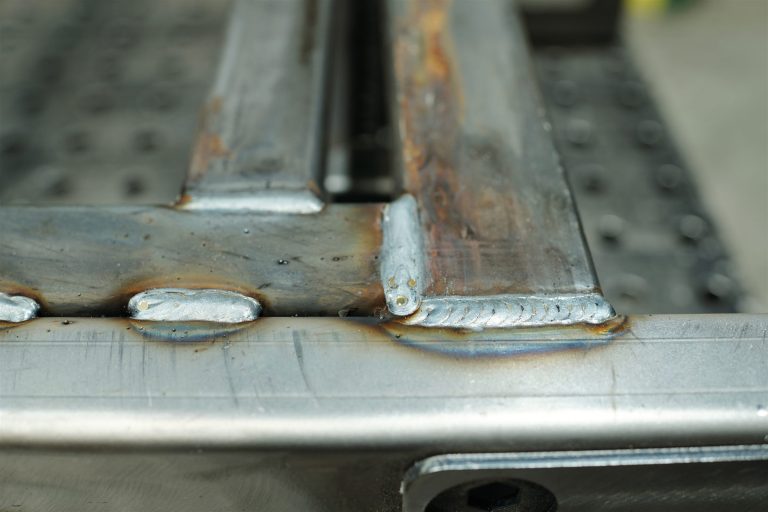 A sanitary weld is ground and polished until it blends into the parent metal rather than standing proud of it. The joint should wipe down in one pass.
Blending matters in one direction in particular. Finishing across the grain of a brushed panel leaves a scuff that traps soil and looks like damage.
The goal is a joint you cannot feel with a gloved hand. If a fingertip catches on it, so will a cloth and so will soil.
Welding heat pulls chromium to the surface as oxide, leaving the colored heat tint you see beside a bead and a chromium-poor layer just beneath it. That tint marks a weakened surface rather than a stain.
Removing the tint and passivating the area restores the surface so it can protect itself again. Skipping it is a common reason a stainless weld rusts in a kitchen.
The same logic applies to new stainless parts built through our metal fabrication service: cleaning and passivation belong to the weld rather than being an optional extra.
Most food-service stainless is one of two grades with one of a small number of finishes, and matching them is what makes a repair invisible.
Grade 304 is the standard for most commercial kitchen equipment and performs well in general service. It is what the majority of tables, shelves, and enclosures are made from.
Grade 316 adds molybdenum, which improves resistance to chlorides. That matters near the coast, in heavy wash-down areas, and anywhere chlorine-based sanitizers are used constantly.
Welding one grade to the other is possible with the right filler, but the joint generally performs to the less resistant of the two. Knowing which grade you are repairing is the first question, not an afterthought. When a part has to be remade rather than repaired, our custom welding work matches the grade to where the piece actually sits.
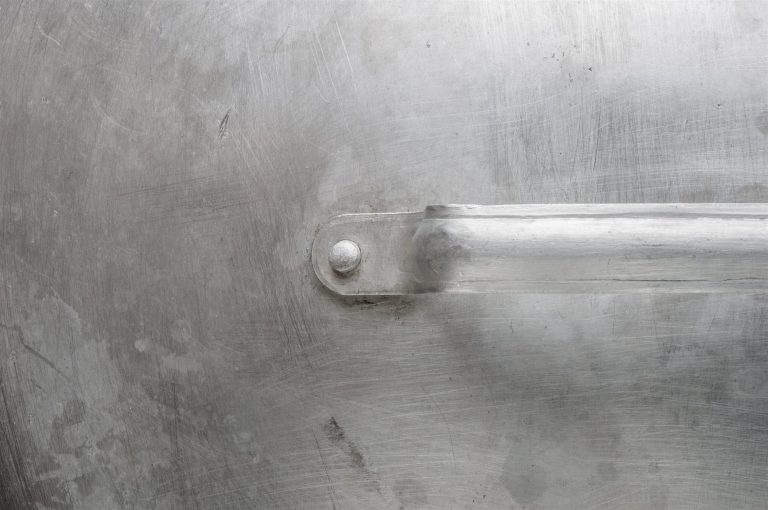 The brushed finish common on kitchen equipment has a direction, and the repair has to follow it. A patch finished at right angles to the surrounding grain is visible from across the room.
Mirror and bead-blasted finishes each need their own approach and are considerably harder to blend. Those are worth flagging before the work rather than after.
Finish also affects cleanability. A rougher surface holds more soil, which is why finishing to match is a hygiene decision rather than only an appearance one.
Free iron transferred from a carbon steel wire brush, grinding disc, or workbench embeds in the stainless surface and then rusts. The stainless is fine; the contamination on it is not.
This is one of the most common causes of what looks like rusting stainless in a kitchen. It often appears as scattered orange speckling rather than as corrosion at a joint.
Dedicated stainless tooling prevents it entirely. Any welder working on food-service equipment should be carrying separate brushes and discs. Our mobile welding service works on stainless as well as mild steel, and keeping the two sets of tools apart stops a repair from leaving the problem it was called to fix.
| What You See | Usual Cause | What It Needs |
|---|---|---|
| Rust at a weld seam | Heat tint never removed or passivated | Clean back and passivate the area |
| Orange speckling across a flat panel | Carbon steel contamination on the surface | Remove the free iron, then passivate |
| Pitting in a wash-down area | Chloride attack on a grade not suited to it | Assess whether 316 is warranted there |
| Cracks at a table leg or corner | Fatigue from flexing at an unsupported joint | Reweld and add support, not just weld |
| Scuffed patch beside a repair | Finished across the grain | Refinish in the direction of the grain |
The local conditions push stainless harder than a drier climate does, and the pattern of failures reflects it.
Salt-carrying air combined with constant humidity means any compromised area starts corroding sooner here than it would inland. Equipment on a covered patio or near an open service window sees the worst of it.
Cleaning regimes add the second pressure. Chlorine-based sanitizers left to sit rather than rinsed off can attack 304 over time, which is why pitting shows up in wash-down zones and around floor-mounted legs.
The third is mechanical. Commercial kitchen equipment gets knocked, leaned on, and dragged, so cracks appear at legs, casters, and corners long before anything wears out.
Those three pressures compound rather than act separately. A leg joint that cracks from flexing exposes bare metal, and the humidity and the sanitizer then work on it from both sides.
That is why a repair here has to close the metal and restore the surface in the same visit. A sound weld left unpassivated in a New Orleans kitchen is a repair with a short life built into it.
Stainless in a kitchen is only as good as the surface protecting it, and welding removes that protection at exactly the point that most needs it. A repair is not finished when the bead is laid.
At Big Easy Mobile Welders, we weld stainless steel on site, including TIG work, with the filler matched to the grade of the equipment. Call us today to have stainless equipment repaired properly rather than patched.
Usually because the protective surface layer has been compromised rather than because the metal is faulty. The common causes are heat tint from welding that was never cleaned off, carbon steel contamination from the wrong brush or disc, and chloride attack from sanitizers left to sit.
A chemical treatment that restores the thin chromium oxide layer giving stainless its corrosion resistance. Welding burns that layer off along the bead, so passivating the area afterward is what stops the weld from rusting. It is a separate step from cleaning the weld.
A weld made so the joint can be cleaned properly: continuous rather than stitched, with no crevices or pits, dressed back and blended into the surrounding finish, and cleaned and passivated afterward. It is the standard for food-preparation and splash-zone equipment.
Both are widely used for food-contact surfaces. Grade 304 is the most common and suits most commercial kitchen equipment, while 316 adds molybdenum for better chloride resistance and is generally considered the higher grade for food contact. The welds and surface finish still decide whether a finished item cleans properly.
Yes, and mobile repair is often preferable to moving heavy equipment. What matters is that the welder carries dedicated stainless tooling, can match the grade and finish, and can clean and passivate the area on site rather than leaving it bare.
For thin stainless and visible sanitary seams, TIG welding is usually the best choice because it gives the finest control over heat, which stainless is sensitive to. MIG is generally faster on thicker stainless and longer runs, and stick can work for heavier repairs. Whatever the process, the filler has to match the grade.
It can be done with the right filler, but the joint takes on the corrosion behavior of the weaker material and is a poor choice for food-service equipment. Where stainless meets a carbon steel structure, the detail matters and is worth specifying rather than improvising.
Usually fatigue from flexing rather than a bad weld. Commercial equipment gets knocked, leaned on, and dragged, and an unsupported leg joint concentrates all of that at one point. Rewelding without adding support simply returns the joint to the same condition.


 By Admin
  Sep 28, 2026