
To stop welds cracking in New Orleans, LA, fix what happens before the arc is struck. Grind both sides to bright metal, fit the joint with the right gap, match the filler and process to the base metal, and control heating and cooling, especially on cast iron. Then remove the load or movement that cracked it, and treat undercut, porosity, or a bead sitting on top of the metal as the mark of a bad repair.
At Big Easy Mobile Welders, we handle emergency repairs as well as custom fabrication, on-site. Many cracked welds are earlier repairs that came apart again.
The pattern is consistent enough to be useful. The same handful of causes account for most cracked welds.
Knowing them is how you stop a weld cracking, and how you judge a repair before it fails rather than after. Contact us today if a weld on your railing, gate, or frame has cracked more than once.
Stop welds cracking by fixing the causes rather than adding more weld. Grind both sides to bright metal, fit the joint with the right gap, match the filler and process to the metal, and control heating and cooling. Then deal with the load or movement that cracked the joint, or the new weld will fail in the same place.
A weld that has cracked is reporting a problem rather than being the problem. That is why a repeat failure at the same joint is significant.
Once is bad luck or a bad weld. Twice means something about the joint, the material, or the load has not been addressed.
Four causes cover the large majority of cracked welds on railings, gates, frames, and brackets.
Paint, rust, galvanizing, oil, and old primer all interfere with fusion. The arc burns through some of it and traps the rest inside the weld as porosity or inclusions.
In this climate, rust is the usual culprit, because a joint that has been outdoors for years is never clean below the surface. Grinding back to bright metal on both sides of the joint is the step that gets skipped when someone is working quickly.
A weld laid over rust looks acceptable when it is new. It is already carrying its own failure inside it.
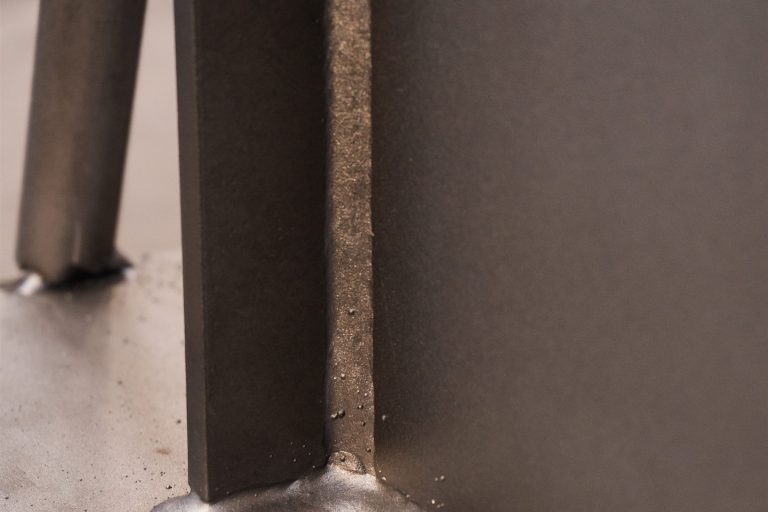 Penetration is how far the weld fuses into the parent metal, and a bead that sits on the surface is holding on by very little. It can look substantial and still be shallow.
Fit-up is the gap between the parts before welding. Too large a gap and the weld is bridging rather than joining; too tight and the weld has nowhere to penetrate.
Both problems come from preparation rather than technique. A joint that was cut and fitted properly is most of the way to a sound weld.
Steel, stainless, aluminum, and cast iron each need their own filler and their own approach, and using the wrong one can leave a joint that is brittle from the moment it cools. Cast iron is the least forgiving of them, and it is frequently welded as though it were steel.
Dissimilar metals joined without the right filler often crack at the interface rather than through the weld itself. That is why a repair can fail cleanly along one side.
Identifying the base metal before welding is not a formality on any custom welding job. It is what decides whether the repair lasts.
Some welds crack because the joint is being asked to carry something it was not built to carry. A gate that has dropped on its hinges drives much of its weight through a single weld, which is why a gate welding service should start with the hinges and the alignment rather than the crack.
Rapid cooling and heavy restraint also lock stress into a joint. A repair made without letting the assembly move can crack as it cools.
Fatigue does the rest. Repeated flexing from a gate swinging, a trailer over potholes, or a railing that gets leaned on concentrates stress at the weakest point over time.
You do not need testing equipment to recognize most poor repairs. Four visual signs cover it.
Undercut is a groove melted into the parent metal at the edge of the weld that was not filled back in. It reduces the thickness of the part exactly where the stress concentrates.
Run a fingernail along the toe of the weld. A distinct step or groove rather than a smooth transition is undercut.
Undercut is one of the clearest warning signs on a finished weld, because it leaves the notch a crack can start from.
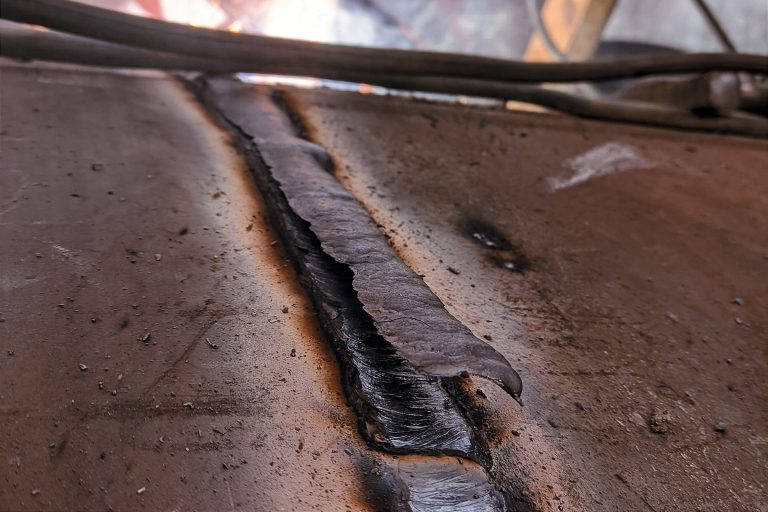 Small holes on the surface of a bead mean gas was trapped as the weld solidified, which usually means contamination or poor shielding. What is visible on the surface often means there is more of it inside.
A weld made outdoors in wind with a shielding-gas process is a common source. Wind blows the shielding away and the weld absorbs the atmosphere.
A few visible pinholes are enough reason to ask what the rest of the joint looks like.
A sound weld transitions smoothly into the parent metal on both sides. A bad one sits proud like a bead of caulk, with a visible line where it meets the metal instead of a blend.
That line is a sign of lack of fusion, where the weld is sitting on the part rather than joined into it. It often fails in one piece, peeling away with the parent metal untouched underneath.
Excessive height is not strength. A tall, lumpy bead usually means too much filler compensating for too little penetration.
Heavy grinding over a repair makes it impossible to read the bead, and that can be the point. A repair that has been ground flat and painted immediately deserves more scrutiny than one left visible.
Body filler over a structural weld is a clear warning. So is fresh paint applied over a joint that was never cleaned back to bare metal.
Ask any iron railing welding service to leave the weld readable, because a joint you can inspect is a joint you can trust.
| What You See | Likely Cause | What It Means |
|---|---|---|
| Groove at the edge of the bead | Undercut from excessive heat or travel speed | A built-in starting point for a crack |
| Pinholes across the surface | Contamination or lost gas shielding | More voids inside than are visible |
| Sharp line where bead meets metal | Lack of fusion | The weld is sitting on, not joined to, the part |
| Rust bleeding from the joint | Welded over rust, or coating never restored | Corrosion is working inside the joint |
| Same joint cracked twice | Load or movement never addressed | Rewelding alone will not hold |
The real test of a repair is not how it looks on the day. It is how it looks after a Louisiana summer and a winter of rain.
A sound repair still has an intact coating over it, with no rust bleeding out from the edge of the weld. That coating is not cosmetic; it is what keeps moisture out of the joint in a humid, salt-carrying environment.
There is no hairline separation at either toe of the weld, and nothing has moved. On a gate or a railing, that usually means the underlying alignment problem was fixed rather than welded around.
Where rust does return first, it is almost always at a spot that was never ground clean. That is worth knowing, because it tells you what to ask for next time.
A weld that keeps cracking is not asking for more weld. It is asking for someone to work out what is loading it, what it is made of, and whether it was ever prepared properly.
At Big Easy Mobile Welders, we clean the metal with a brush or grinder before welding, and we do the work on-site. Call us today to have a cracked weld looked at properly.
Because the underlying cause has not been removed. A repeat failure at one joint usually means the load, the movement, or the fit-up is wrong rather than the weld itself. Rewelding without addressing it reproduces the same crack in the same spot.
You can, and the joint will be compromised. Rust traps oxides and moisture inside the weld, producing porosity and poor fusion. Grinding back to bright metal on both sides of the joint is the step that separates a repair that lasts from one that looks fine and fails.
Look for a groove cut into the parent metal at the edge of the bead, pinholes on the surface, a bead sitting proud with a sharp line where it meets the metal, and heavy grinding or filler used to hide the shape. Any of those is worth questioning.
A groove melted into the base metal at the edge of the weld that was not filled back in. It thins the part exactly where stress concentrates and creates the notch a crack starts from. Running a fingernail along the toe of the weld usually finds it.
There is no single answer, but cast iron is among the hardest common metals to repair. Its carbon content, often around 2 to 4 percent, makes it brittle, so it cracks when heated or cooled too quickly unless it is preheated and cooled slowly. Galvanized steel is difficult for another reason, because the zinc coating gives off hazardous fumes.
If a weld pops and spatters while you are welding, the usual causes are dirty or rusty metal, lost shielding gas, or wire speed and voltage set out of balance. If finished welds pop loose, the bead usually never fused into the parent metal, which traces back to poor preparation or too little heat.
It can. Wind blows away the shielding gas that protects the molten weld, which lets the weld absorb the atmosphere and produces porosity. A competent mobile welder manages this with screens, process selection, and wire choice rather than ignoring it.
No. A tall, lumpy bead usually means excess filler compensating for insufficient penetration, so the joint is weaker than it appears. Strength comes from fusion into the parent metal, which is why a sound weld blends smoothly into the part on both sides.


 By Admin
  Sep 7, 2026